How to Choose the Right Tech Stack for Your Web Application in 2026
A comprehensive guide on selecting between SPAs, SSR frameworks, monolithic architectures, and microservices for your next web project.
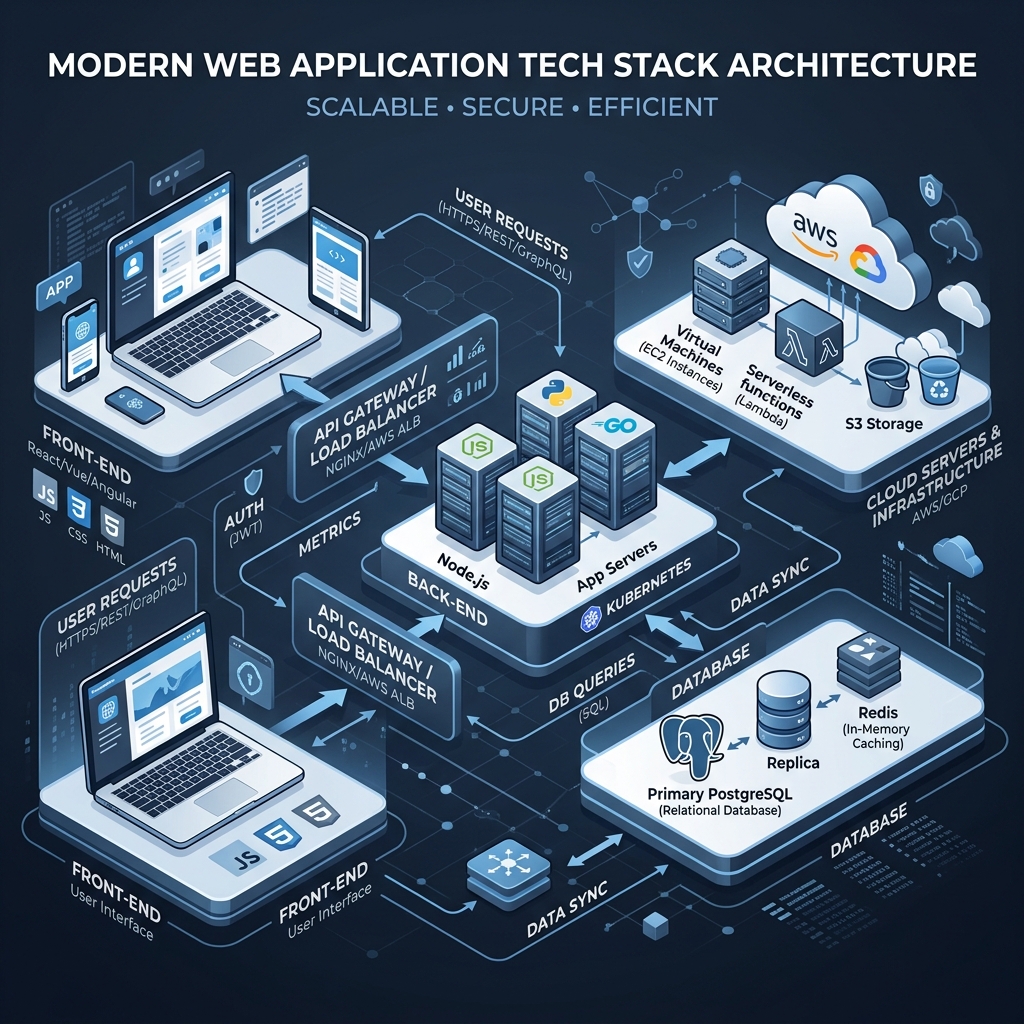
Choosing the right technology stack for your web application is one of the most critical decisions a startup or established business can make in 2026. A poor choice can lead to a sluggish user experience, difficult maintenance, and expensive rewrites, while the right stack ensures scalability, developer velocity, and performance.
Single Page Applications (SPA) vs. Server-Side Rendering (SSR)
Historically, Single Page Applications (built with React, Vue, or Angular) dominated the modern web. They provide a highly interactive, desktop-like experience by loading a single HTML page and updating the content dynamically via JavaScript. However, SPAs often suffer from slow initial load times and poor SEO capabilities since web crawlers struggle to index JavaScript-heavy pages.
In 2026, the industry standard has shifted decisively towards Server-Side Rendering (SSR) and Static Site Generation (SSG) frameworks like Next.js (React) and Nuxt.js (Vue). These frameworks pre-render pages on the server, delivering fully formed HTML to the browser. This approach drastically improves initial load speed and SEO while maintaining the interactive benefits of an SPA once loaded.
Monolith vs. Microservices Architecture
Another fundamental choice is the backend architecture. Should you build a monolithic application or a microservices-based system?
- Monolithic Architecture: The entire application is built as a single, unified unit. This is often the best choice for startups or MVP (Minimum Viable Product) development due to its simplicity, easier deployment, and lower operational overhead.
- Microservices Architecture: The application is divided into small, independent services that communicate via APIs. This is ideal for large, complex applications with multiple teams working concurrently, as it allows independent scaling and deployment.
Technical Comparison
| Feature | Monolithic Architecture | Microservices Architecture |
|---|---|---|
| Complexity | Low (Easy to manage initially) | High (Requires robust DevOps) |
| Scalability | Scales the entire app at once | Scales specific services independently |
| Deployment | Single deployment unit | Multiple, independent deployments |
| Best For | Startups, MVPs, Small Teams | Enterprises, Large Complex Systems |
Database Selection: SQL vs. NoSQL
Your database choice heavily depends on the structure of your data. Relational databases (SQL) like PostgreSQL and MySQL are unmatched for structured data with complex relationships and strict ACID (Atomicity, Consistency, Isolation, Durability) requirements. On the other hand, NoSQL databases like MongoDB or DynamoDB offer flexibility for unstructured data and rapid prototyping, though they can become difficult to query as complexity grows.
LPG DEV's Technical Opinion
At LPG DEV, we strongly advocate for a pragmatic approach. For most new web applications and MVPs, we recommend a Next.js frontend paired with a well-structured monolithic Node.js backend and a PostgreSQL database. This stack provides the perfect balance of performance, SEO, developer productivity, and scalability. Premature optimization with microservices often slows down time-to-market without providing immediate benefits.
Ready to build a robust, scalable web application? Explore our Web Application Development services to see how we can bring your vision to life.